

TWO FRIENDS, TWO AGEING PARENTS, ONE SHARED QUESTION:
HOW TO LIVE MEANINGFULLY TO THE END?
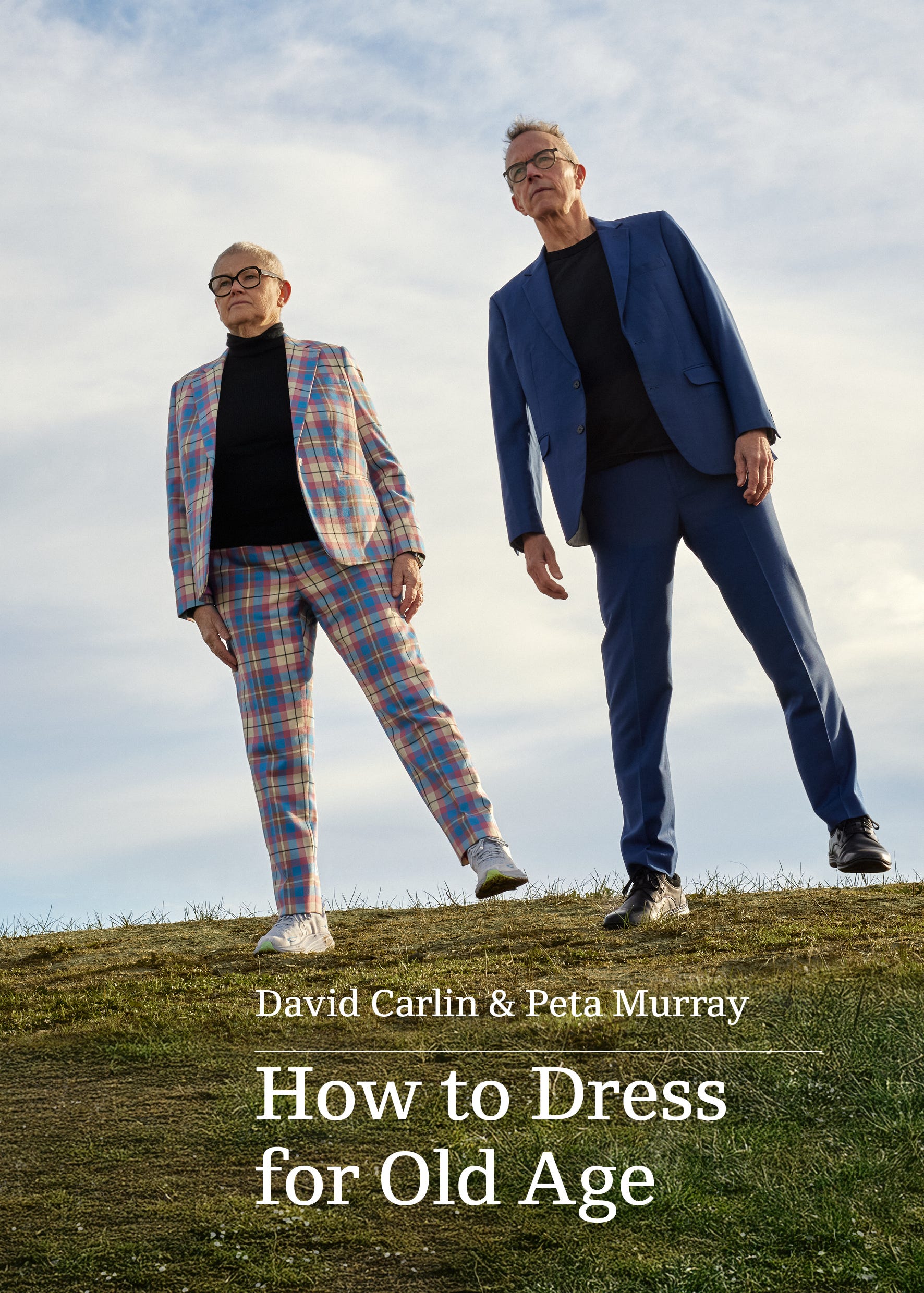
Weaving memory, anecdote and reflection, How to Dress for Old Age is a work of love and reckoning showcasing two of Australia’s finest writers at the peak of their powers.
When adult children take up caring for absent fathers and stoicmothers, things can get complicated.
Room 306. Level Three. In inner city Melbourne, David Carlin’s
mother, Joan, is settling in. Five doors away, on the same floor of
the same institution, Peta Murray’s father, Frank, is halfway
through the statistically ordained 18 months he is likely to live
after entering “care”. Each is 86. He—an ex-builder and sometime
bon vivant—has shrunk inside his grey marle tracksuit but still fits
proudly into his Sixth Form blazer. She—a widowed mother of
three since the age of 31, turned activist, community leader and
doer-of-many-things—is throwing on colourful scarves and
preparing to re-invent herself again.
Murray and Carlin take up the labour of care for their ageing
parents while contemplating their own “third age”. Murray is 60
and an early career researcher in a late career body. Carlin is a
newly minted professor at 55, thinking about escape. Each is yet
to fully imagine what comes next.
Tender, funny and confronting, the book’s dual voices unfold along parallel and
intersecting tracks, queer and straight, female and male. Part valedictory, part
costume parade, it charts the complex dance steps of Father and Daughter, and
Mother and Son, as they try on countermoves to the diminishments of age and the
pervasive forces of ageism, inside and out.
ABOUT THE AUTHORS
Peta Murray is known for plays Wallflowering, and Salt, as well as AWGIE-winning works of community theatre Spitting Chips and The Keys to the Animal Room. Peta’s short fiction has been published in Sleepers Almanac and New Australian Stories. Senior Lecturer at RMIT University in Melbourne, she is a co-editor and contributor to Bloomsbury Academic’s A-Z of Creative Writing Methods. Her essays have appeared in Sydney Review of Books, The Mekong Review and TEXT Journal.
David Carlin’s books include Our Father Who Wasn’t There, The Abyssinian Contortionist, and The After-Normal. His essays have appeared in Overland, Meanjin, Griffith REVIEW, Hunger Mountain, Westerly and Sydney Review of Books. David began his career as a writer/director with Red Shed Theatre, Melbourne Workers Theatre, Circus Oz and Arena Theatre, and has made award-winning films and radio essays. Co-President of the NonfictioNOW conference and Emeritus Professor at RMIT, he co-founded the WrICE cultural exchange program and non/fictionLab.
this sounds fabulous! (lisa nahmanson)